

core-db is Kumoss’s system of record: who the users are, what they asked for, and what each run produced. Thirteen tables hold it. Everything else — traces, cached session facts, the generated files themselves — lives outside this database.
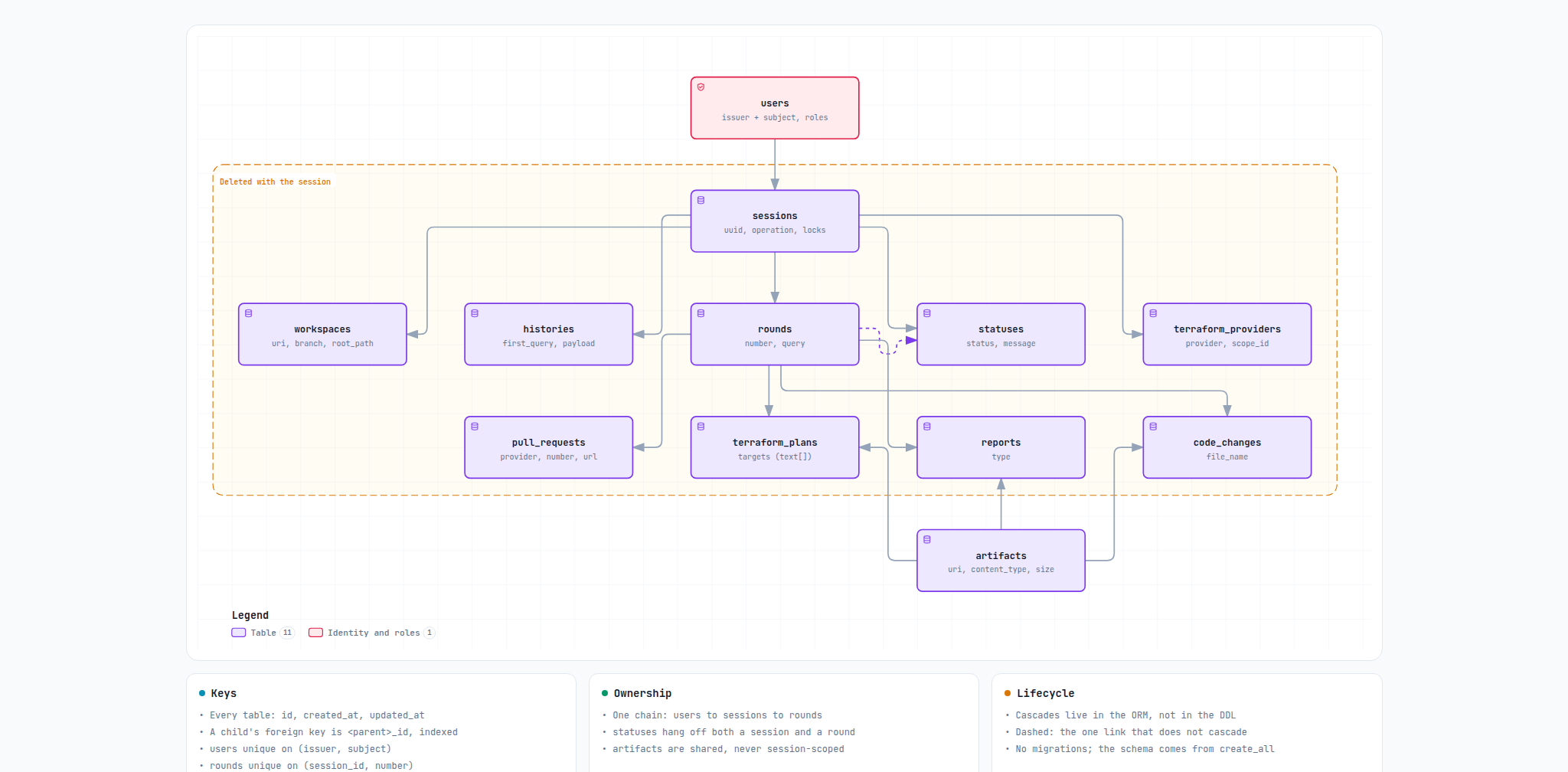
Pan, zoom, search, trace a relationship, switch themes. Open in a new tab
Conventions
Every table follows the same three rules, so they are stated once here rather than repeated per table:
-
Each table has an auto-incrementing integer
idprimary key, pluscreated_atandupdated_attimestamps that carry a time zone. -
A child’s foreign key is named after its parent —
session_id,round_id,user_id,artifact_id— and is indexed. -
Two uniqueness rules exist:
usersis unique on(issuer, subject), androundsis unique on(session_id, number).
The tables
| Table | Belongs to | What it records |
|---|---|---|
|
— |
One row per identity, keyed by the OIDC |
|
|
One request from creation to completion: a public |
|
|
One turn within a session — its |
|
|
The repository the session works against: |
|
|
Which clouds the session targets, and the |
|
|
The conversation carried across rounds: the |
|
|
The progress trail. Each row is one |
|
|
A pull request the round opened: the git |
|
— |
Metadata for one stored object: its |
|
|
A plan produced by a round, with the |
|
|
A report produced by a round, tagged with its |
|
|
The compliance audit of a generate round: its |
|
|
One generated or modified file, by |
The four artifact-metadata tables — terraform_plans, reports,
compliance_checks, and code_changes — each point at both a round and
an artifact. The round says which turn produced it; the artifact says
where the bytes are. The bytes themselves are never in the database.
Enumerated columns
Seven columns are constrained to a fixed set of values:
| Column | Table | Values |
|---|---|---|
|
|
|
|
|
|
|
|
|
|
|
|
|
|
|
|
|
|
|
|
|
Note that apply is a report type and a progress status, but not a
session operation: an apply runs inside the session that generated the
plan rather than starting one of its own.
For what the two role columns actually permit, see Roles and permissions.
Deleting a session
Deleting a session removes the five tables that hang off it — its workspaces, terraform providers, histories, statuses, and rounds — and, through the rounds, their pull requests, plans, reports, compliance checks, and code changes. Deleting a user removes that user’s sessions the same way. This is the dashed region in the diagram.
Two things stay behind. artifacts rows are shared and are never removed
with a session; the objects they describe are managed in object storage
on their own schedule. And the link from a round to its statuses does not
cascade — statuses are cleaned up through the session that owns them, not
through the round. That is the dashed edge in the diagram.
|
These cascades are enforced by the application’s object mapper, not by
database |
Changing the schema
There is no migration tooling. The schema is created from the application’s model definitions at startup, which creates missing tables but never alters existing ones. A column added to a model will not appear in a database that was created before it.
In practice this means an existing core_db_data volume has to be migrated
by hand or recreated whenever the model changes. The upgrade that introduced
authentication is the case most deployments hit: sessions used to be keyed by
a username column and there was no users table at all.
For the other stores — Phoenix, Redis, object storage, and the workspaces volume — see Data and state.