

This page describes how Kumoss’s containers are deployed on one Docker Compose stack, the operational notes that follow from that topology, and the architectural characteristics that result from the decisions described across this section.
Infrastructure diagram
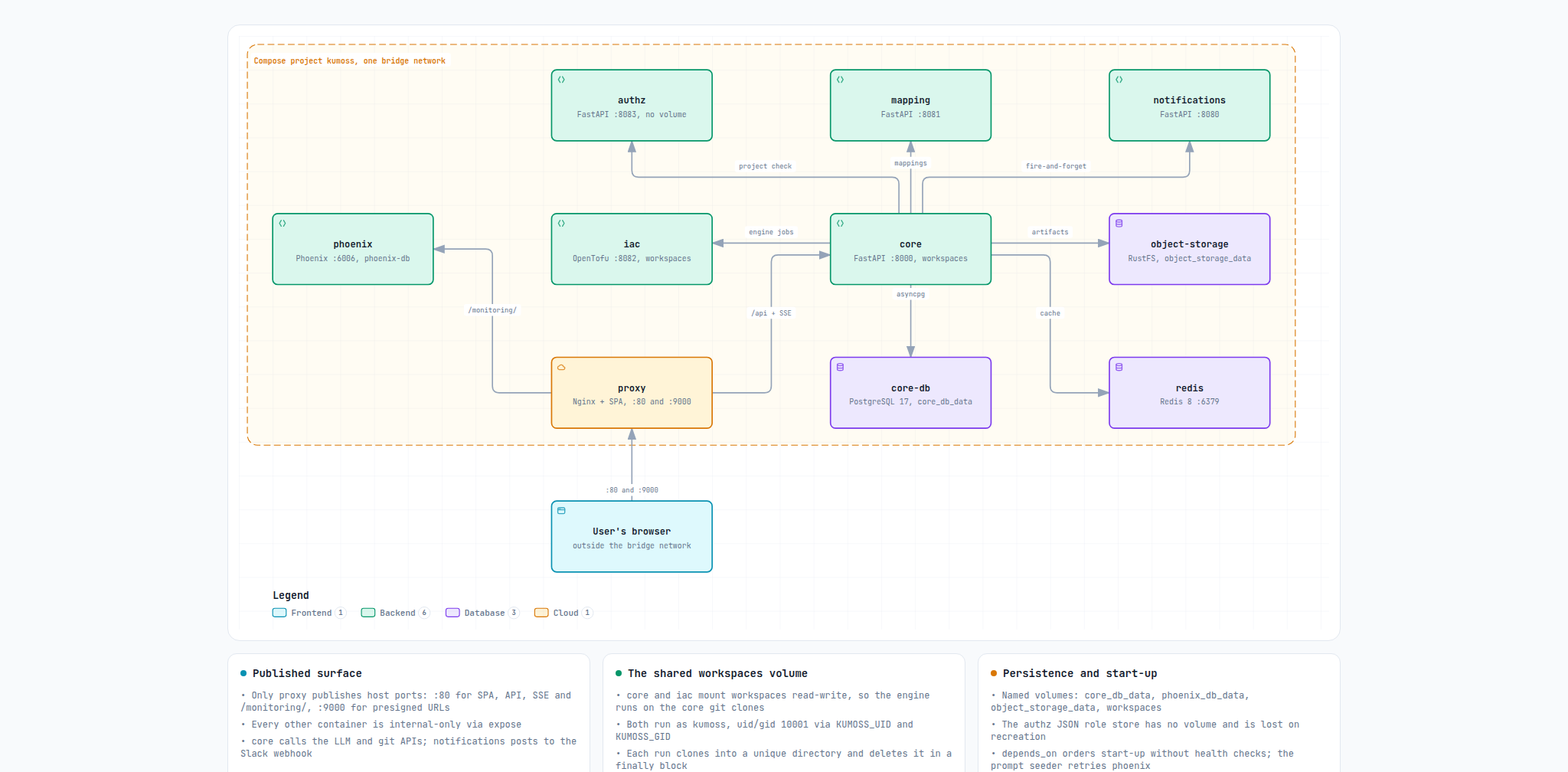
The block diagram below shows the deployment topology: every container in the Compose project, the host ports published by the proxy, and the calls between them. The user’s browser sits outside the bridge network on purpose.
Pan, zoom, search, trace a relationship, switch themes. Open in a new tab
Named volumes are written into each container’s subtitle instead of
being drawn as separate nodes (core_db_data, phoenix_db_data,
object_storage_data, and workspaces), and phoenix-db is folded
into the phoenix node, so the eleventh container of the stack is not a
box of its own. Two edges are left out because the
system architecture diagram already
carries them — the core’s OTLP traces and prompt calls to Phoenix, and
the proxy’s port 9000 path to object storage — and the connections that
leave the stack (LLM and git provider APIs from the core, the Slack
webhook from notifications) appear in the notes beside the diagram
rather than as external nodes.
Only the proxy publishes host ports; all other containers are reachable
solely on the internal network. The workspaces volume is the one
mount shared by two containers (core and iac), which is what lets the
iac service run the IaC engine against the core’s git clones. Both
containers run as the same unprivileged user (kumoss, uid/gid 10001,
fixed by the KUMOSS_UID/KUMOSS_GID build args) so files either one
creates are writable by the other. Additional Compose hardening for the
iac container (dropping all capabilities, no-new-privileges, a
read-only root filesystem, and CPU/memory/pid limits) was prototyped
but is not present in the checked-in docker-compose.yml; it remains a
recommended deployment hardening because the container executes
provider code from generated HCL.
Operational notes
The Compose stack described here is the local/non-production deployment model and the reference topology for production; the repository ships no Kubernetes manifests or Helm charts.
Topology
-
All eleven containers share one Docker bridge network. Only
proxypublishes host ports: 80 (SPA, API, SSE, monitoring) and 9000 (presigned object-storage access); every other service is internal-only viaexpose. -
Compose
depends_onorders start-up (it does not health-check): core waits for core-db, Redis, object storage, and all four sidecars; the proxy waits for core, Phoenix, and object storage. The core has no Compose dependency on Phoenix, which is why its prompt seeder retries. -
Four named volumes persist state:
core_db_data,phoenix_db_data,object_storage_data, andworkspaces. The authz sidecar’s JSON role store has no volume and does not survive container recreation.
Core start-up
-
The FastAPI lifespan enforces a strict order: database, then Redis, then object-storage bucket creation, then Phoenix prompt seeding. Failure of any step aborts boot. Git credential configuration follows and is best-effort.
-
Configuration comes from a single
config.yaml, baked into the image at/etc/kumoss/config.yamlby the core Dockerfile, so changes require an image rebuild unlessKUMOSS_CONFIGpoints at a file mounted elsewhere in the container. -
Secrets never appear in the file:
*envfields name environment variables (database URL, service bearer tokens, storage keys, git personal access token), and the core validates at boot that every enabled service’s token and every referenced LLM credential resolves. EachKUMOSS<SERVICE>_TOKENmust match between the core’s outbound client and the sidecar’s inbound validation. -
Authentication needs no secret: the
oidcblock andadmin.default_root_emailare plain configuration that Pydantic validates at load, so anissuer_urlwithout aclient_idfails the boot; discovery and JWKS are fetched lazily on the first request, so a wrong or unreachable issuer surfaces as a401at first login, not at boot. Operationally, what matters here is that enabling or changing OIDC meansdocker compose build core, and that the IdP must have<origin>/auth/callbackregistered as the SPA redirect URI.
Operational limits and single-instance assumptions
The stack is designed as one core process. These are the consequences to plan for before running more than one:
-
Runs are in-process background tasks. A core crash or restart mid-run leaves
sessions.in_flight = truewith no lease and no expiry, and the compare-and-set will refuse the session for ever; recovery is a manualUPDATE sessions SET in_flight = false. -
The
workspacesvolume must be shared and persistent across replicas. A pinned plan lives on disk at/workspaces/<session>/pinned, so an apply routed to a replica that did not run the generate round finds no pinned plan and fails the session. -
Only the PostgreSQL compare-and-set is replica-safe. Redis holds no locks; its single-flight registry is an in-process
asyncio.Lockper key, so it de-duplicates cache misses within one process only. -
Static storage credentials are rendered in plaintext into
backend_override.tfon the shared volume when Kumoss-managed state is used with access/secret keys or an Azure account key. Prefer credential chains or workload identity where the provider allows it. -
One Git identity for every user. All pushes and pull requests use the single PAT in
GIT_TOKEN, and commits are authored, by default, asKumoss <kumoss@noreply.invalid>(git.author_name/git.author_email), so repository history attributes nothing to the requesting user — the session record in core-db is the audit trail. -
The artifact proxy on port 9000 answers
Access-Control-Allow-Origin: *. Presigned URLs are the only access control on that port.
Architectural characteristics
-
Ports and adapters. Domain services depend on interfaces, infrastructure adapters implement them, and a per-run factory wires the object graph explicitly, so LLM providers, git hosts, Terraform execution, and storage backends are replaceable through configuration alone.
-
Contract-first sidecars. OpenAPI specifications are the authoritative boundary, with generated clients on one side and intentionally minimal reference implementations on the other, inviting substitution in enterprise deployments.
-
Deliberately direct execution. Pipelines run as in-process background tasks with a database compare-and-set as the only concurrency control; sidecar calls are synchronous HTTP with job polling rather than event-driven messaging; SSE progress derives from status polling. These are visible trade-offs, not accidents.
-
Deep, centralized telemetry. Model calls, tool executions, and engine runs are traced to Phoenix, which doubles as the runtime prompt registry, making prompt management an operational concern rather than a code change. No tracing decorator exports anything when the wrapped call raises: most of them build the span only after the call returns, and the chain decorator, which does create its span first, never ends it on an exception. Failures are therefore visible in the logs and the session status, not as error spans, and the sidecars are not instrumented at all.
-
LLM audits LLM, code decides. The compliance auditor is a separate agent loop with no repository access at all — its only tool is the sentinel
report_compliance_findings; the pass/fail verdict is computed deterministically from the structured violations it reports, and the resulting database lock is what actually stops a non-compliant plan from being applied. -
Stateless, local identity. The core trusts only a signed JWT from the single configured issuer, validates it on every request without an introspection round-trip, and keeps users, roles, and session ownership in its own database, so federation, MFA, and session policy stay the identity provider’s concern.